You don’t, because the second 2 is associated with a Division that has to be done before the addition. Maybe go back to school and learn how to do Maths 🙄
Right, so you cannot derive precedence order from the definition of the operations. Your argument based on the definition of multiplication as repeated addition is wrong.
or you get wrong answers
This is begging the question. We are discussing whether the answers are flat wrong or whether there is a layer of interpretation. Repeating that they are wrong does nothing for this discussion, so there’s no need to bother.
You have nothing to say that I can see about why the different interpretations are impossible, or contradictory, or why they ought to qualify as “wrong” even though maths works regardless; you’ve just heard a school-level maths teacher tell you it’s done one way and believe that’s the highest possible authority. I’m sorry, but lots of things we get taught in high school are wrong, or only partially right. I see from your profile that you are a maths teacher, so it’s actually your job to understand maths at a higher level than the level at which you teach it. It may be easier to to teach high school maths this way, but it’s not a good enough level of understanding for an educator (or for a mathematician).
Left to right is a convention (as is not writing the brackets in RPN). Brackets before Multiplication before Addition are rules.
OK, let’s try a different tack. When I hear the word “rules”, I think you’re talking either about a rule of inference in first order logic or an axiom in a first-order system. But there is no such rule or axiom in, for example, first order Peano arithmetic. So what are you talking about? Can you find somewhere an enumeration of all the rules you’re talking about? Because maybe we’re just talking at cross-purposes: if you deviate from the axioms of Peano arithmetic then we’re fundamentally not doing arithmetic any more. But I contend that you will not find included in any axiomatisation anything which specifies order of operations. This is because from the point of view of the “rules” (i.e. the axioms) the addition and multiplication operations are just function symbols with certain properties. Even the symbols themselves are not really part of the axiomatisation; you could just as well get rid of the + symbol and write A(x, y, z) instead of “x + y = z”; you’d have the exact same arithmetic, the exact same rules.
If you’re able to answer this, we can get away from these vague terms which you keep introducing like “notation definition”, and we can instead think about what it means to be a convention versus whatever it is you mean by “rule”. (For example, Peano arithmetic has a privileged position amongst candidates for arithmetic because it encompasses our intuition about how numbers work: you can’t just take an alternative arithmetic, like say arithmetic modulo 17, and say that’s an “alternative convention” because when you add an apple to a bowl of 16 apples, they don’t all disappear. But there’s no such intuition about how to write mathematics to express a certain thing. I contend that is all convention.)
It works because it treats every operation as bracketed without writing the brackets. Also that’s only a Maths notation, not the Maths itself.
So, you understand that a notation can evaluate things in a certain order with what you call “treating every operation as bracketed without writing brackets.” What does it mean to be “bracketed without writing brackets”? There are exactly two aspects to brackets:
the symbols themselves - but we’re not writing them! So this isn’t relevant.
the effect they have - the effect on the order of evaluation of operations
So what you’re admitting with these phantom brackets is that a notation can evaluate operations in a different order, even though there are no written brackets.
So I can specify these fake brackets to always wrap the left-most operation first: (2 + 3) x 5 and hey look, this notation now has left-to-right order of evaluation, not the usual multiplication first. If you prefer to think of there being invisible brackets there, go right ahead, but the effect is the same.
So, how do we decide whether our usual notation “has bogus brackets” or not? Convention. We could choose one way or the other. Nothing breaks if we choose one or the other. Symmetrically, we could say that left-to-right evaluation is the notation “without bogus brackets” and that BODMAS evaluation is the notation “with bogus brackets”. Which choice we make is entirely arbitrary. That is, unless you can find a compelling reason why one is right and the other wrong, rather than just saying it once again.
They don’t actually. Welcome to most e-calcs give wrong answers because the programmers failed to deal with it correctly.
What problems does it cause? Are the problems purely that they don’t have the order of operations you expect, and so get different answers if you don’t clarify with brackets? Because that, again, is begging the question.
To re-iterate, you are in a discussion where you’re trying to establish that it’s a fundamental law of maths that you must do multiplication before addition. The fact that you’ve written a post in which you document how some calculators don’t follow this convention and said that they’re wrong is not evidence of that. It’s just your opinion. Indeed, it’s really (weak) evidence that your opinion is wrong, because you’re less of an authority than the manufacturers of calculators.
On calculators, there’s something important you need to realise: basic, non-scientific, non-graphing calculators all have left-to-right order of operations. You can test this with e.g. windows calculator in “standard” mode by typing 2, +, 3, x, 5 (it will give you 25, not 17). Switch it to “scientific” mode and it will give you 17.
Why is it different? Because “standard” mode is emulating a basic calculator which has a single accumulator and performs operations on that accumulated value. When you type “x 2” you are multiplying the accumulator by 2; the calculator has already forgotten everything that you typed to get the accumulator. This was done in the early days of calculators because it was more practical when memory looked like this:
Now, you can go on about your bogus brackets until you’re blue in the face, but the fact is that this isn’t “wrong”. It has a different convention for a sensible reason and if you expect something different then it is you who are using the device wrong.
From your other comment, since having two threads seems pointless:
So if you have one “notation definition” as you call it which says that 2+2*3 means ”first add two to two, then multiply by three” and another which says “first multiply two by three, then add it to two”, why on earth do the “rules” have anything further to say about order of operations?
No we don’t. We have another notation which says to do paired operations (equivalent to being in brackets) first.
What do you mean “we don’t”? I just made the definition. It exists. This is why terms like “notation definition” are not actually helpful IMO, so let’s be precise and use terms that are either plain english (like “convention”) or mathematical (like “axiom”, “definition”, etc).
Right, so you cannot derive precedence order from the definition of the operations.
Yes you can. I’m not sure what you’re not understanding about Division before Addition 😂
Your argument based on the definition of multiplication as repeated addition is wrong
No it isn’t! 😂
We are discussing whether the answers are flat wrong or whether there is a layer of interpretation
Flat wrong, as per the rules Of Maths 🙄
Repeating that they are wrong does nothing for this discussion, so there’s no need to bother
So stop doing wrong things and I can stop saying you’re doing it wrong 😂
why they ought to qualify as “wrong” even though maths works regardless
If you have 1 2 litre bottle of milk, and 4 3 litre bottles of milk, even a 3rd grader can count up and tell you how many litres there are, and that any other answer is wrong. 🙄 2+3x4=2+3+3+3+3=14 correct 2+3x4=5x4=5+5+5+5=20 wrong See how the Maths doesn’t work regardless? 😂
you’ve just heard a school-level maths teacher tell you it’s done one way and believe that’s the highest possible authority
Nope, I’ve proven it myself - that’s the beauty of Maths, that anyone at all can try it for themselves and find out. I’m guessing that you didn’t try it yourself 😂
lots of things we get taught in high school are wrong
says person failing to give a single such example 🙄
it’s actually your job to understand maths at a higher level than the level at which you teach it
No it isn’t. I’m required to to get the Masters degree which is required to be a teacher here, and that’s the end of it.
It may be easier to to teach high school maths this way
The correct way, yes 😂
When I hear the word “rules”, I think you’re talking either about a rule of inference in first order logic or an axiom in a first-order system
Nope, neither.
So what are you talking about?
What don’t you understand about 20 being a wrong answer for 2+3x4??
whatever it is you mean by “rule”
Thing which results in wrong answers if disobeyed - like 2+3x4=20 - not complicated. This is what we teach to students - if you always obey all the rules then you will always get the correct answer.
arithmetic modulo 17, and say that’s an “alternative convention”
Of course not, just a different function of Maths, that doesn’t involve Arithmetic at all (other than the steps along the way in doing the long division), unlike 2+3x4 🙄
I contend that is all convention
Nope! Just a different rule to Arithmetic 🙄
What does it mean to be “bracketed without writing brackets”?
Same thing as we’re adding the 2 in 2+3 without writing a plus (or a zero) in front of the 2 - all Arithmetic starts from zero on the number-line. Maths textbooks explicitly teach this, that we can leave the sign omitted at the start if it’s a plus.
the symbols themselves - but we’re not writing them! So this isn’t relevant
Just like we aren’t writing the plus sign in 2+3 🙄
So what you’re admitting with these phantom brackets is that a notation can evaluate operations in a different order, even though there are no written brackets.
Nope. Same order as though we did write it in a notation using Brackets, same as we always start with adding the 2 even though we didn’t write a plus sign in 2+3.
So I can specify these fake brackets to always wrap the left-most operation first: (2 + 3) x 5
No you can’t, because you get a wrong answer 🙄
this notation now has left-to-right order of evaluation
No it doesn’t, Multiplication before Addition 🙄
If you prefer to think of there being invisible brackets there
You know we were writing this without brackets for several centuries before we started using brackets in Maths, right?? 😂
So, how do we decide whether our usual notation “has bogus brackets” or not? Convention
Nope. proven rules 🙄
We could choose one way or the other.
No we can’t. Even a 3rd grader who is counting up can tell you that 🙄
Nothing breaks if we choose one or the other.
Yes it does. Again ask the 3rd grader how many litres we have, and then try doing Addition first to get that answer 😂
we could say that left-to-right evaluation is the notation “without bogus brackets”
No we can’t. Ask the 3rd grader, or even try it yourself with Cuisenaire rods
Which choice we make is entirely arbitrary
Nope. proven rules 🙄
That is, unless you can find a compelling reason why one is right and the other wrong, rather than just saying it once again
Count up how many litres we have 🙄
What problems does it cause?
wrong answers 😂
you’re trying to establish that it’s a fundamental law of maths that you must do multiplication before addition
As per Maths textbooks 😂
you’ve written a post in which you document how some calculators don’t follow this
rule
said that they’re wrong is not evidence of that
says person ignoring the Maths textbooks I quoted and the actual calculators giving the correct answer 🙄
It’s just your opinion
Nope! proven rules as found in Maths textbooks 🙄
it’s really (weak) evidence that your opinion is wrong,
says person ignoring the Maths textbooks I quoted and the actual calculators giving the correct answer 🙄
you’re less of an authority than the manufacturers of calculators
Demonstrably not 😂
basic, non-scientific, non-graphing calculators all have left-to-right order of operations
No they don’t! 😂
e.g. windows calculator in “standard” mode
The Windows calculator is an e-calc which was written by a programmer who didn’t check that their Maths was correct. 🙄 Now try it with any actual calculator 🙄
Why is it different?
Written by a different programmer, but one who didn’t know The Distributive Law, so even in Scientific mode it gives wrong answers to 8/2(1+3) 🙄
Because “standard” mode is emulating a basic calculator
No it isn’t. All basic calculators obey Multiplication before Addition, 🙄 and if the programmer had tried it then they would’ve found that out
performs operations on that accumulated value
Instead of using the stack, to store the Multiplication first, like all actual calculators do 🙄
When you type “x 2” you are multiplying the accumulator by 2
No, the dumb programmer is. All actual calculators did the Multiplication first and put the result on the stack
the calculator has already forgotten everything that you typed to get the accumulator
But actual calculators have put that result on the stack 🙄
This was done in the early days of calculators
No it wasn’t. All calculators “in the early days” used the stack
It has a different convention for a sensible reason
Nope, it’s just disobeying the rules of Maths because dumb programmer didn’t check their Maths was correct 🙄
it was more practical when memory looked like this:
And even then the stack existed 🙄
the fact is that this isn’t “wrong”
Yes it is! 😂 Again, ask the 3rd grader to count up and tell you the correct answer
if you expect something different then it is you who
knows the rules of Maths 🙄
What do you mean “we don’t”?
What don’t you understand about “we don’t”?
I just made the definition
Of the notation, not the rules 🙄
We have another notation which says to do paired operations (equivalent to being in brackets) first
And this notation says to do paired operations first, same as if they were in Brackets. You so nearly had it 🙄
plain english (like “convention”)
says person who keeps calling the rules “convention” 🙄
mathematical (like “axiom”, “definition”, etc)
You know we have Mathematical definitions of the difference between conventions and rules, right??



Right, so you cannot derive precedence order from the definition of the operations. Your argument based on the definition of multiplication as repeated addition is wrong.
This is begging the question. We are discussing whether the answers are flat wrong or whether there is a layer of interpretation. Repeating that they are wrong does nothing for this discussion, so there’s no need to bother.
You have nothing to say that I can see about why the different interpretations are impossible, or contradictory, or why they ought to qualify as “wrong” even though maths works regardless; you’ve just heard a school-level maths teacher tell you it’s done one way and believe that’s the highest possible authority. I’m sorry, but lots of things we get taught in high school are wrong, or only partially right. I see from your profile that you are a maths teacher, so it’s actually your job to understand maths at a higher level than the level at which you teach it. It may be easier to to teach high school maths this way, but it’s not a good enough level of understanding for an educator (or for a mathematician).
OK, let’s try a different tack. When I hear the word “rules”, I think you’re talking either about a rule of inference in first order logic or an axiom in a first-order system. But there is no such rule or axiom in, for example, first order Peano arithmetic. So what are you talking about? Can you find somewhere an enumeration of all the rules you’re talking about? Because maybe we’re just talking at cross-purposes: if you deviate from the axioms of Peano arithmetic then we’re fundamentally not doing arithmetic any more. But I contend that you will not find included in any axiomatisation anything which specifies order of operations. This is because from the point of view of the “rules” (i.e. the axioms) the addition and multiplication operations are just function symbols with certain properties. Even the symbols themselves are not really part of the axiomatisation; you could just as well get rid of the + symbol and write A(x, y, z) instead of “x + y = z”; you’d have the exact same arithmetic, the exact same rules.
If you’re able to answer this, we can get away from these vague terms which you keep introducing like “notation definition”, and we can instead think about what it means to be a convention versus whatever it is you mean by “rule”. (For example, Peano arithmetic has a privileged position amongst candidates for arithmetic because it encompasses our intuition about how numbers work: you can’t just take an alternative arithmetic, like say arithmetic modulo 17, and say that’s an “alternative convention” because when you add an apple to a bowl of 16 apples, they don’t all disappear. But there’s no such intuition about how to write mathematics to express a certain thing. I contend that is all convention.)
So, you understand that a notation can evaluate things in a certain order with what you call “treating every operation as bracketed without writing brackets.” What does it mean to be “bracketed without writing brackets”? There are exactly two aspects to brackets:
So what you’re admitting with these phantom brackets is that a notation can evaluate operations in a different order, even though there are no written brackets.
So I can specify these fake brackets to always wrap the left-most operation first:
(x 5 and hey look, this notation now has left-to-right order of evaluation, not the usual multiplication first. If you prefer to think of there being invisible brackets there, go right ahead, but the effect is the same.2 + 3)So, how do we decide whether our usual notation “has bogus brackets” or not? Convention. We could choose one way or the other. Nothing breaks if we choose one or the other. Symmetrically, we could say that left-to-right evaluation is the notation “without bogus brackets” and that BODMAS evaluation is the notation “with bogus brackets”. Which choice we make is entirely arbitrary. That is, unless you can find a compelling reason why one is right and the other wrong, rather than just saying it once again.
What problems does it cause? Are the problems purely that they don’t have the order of operations you expect, and so get different answers if you don’t clarify with brackets? Because that, again, is begging the question.
To re-iterate, you are in a discussion where you’re trying to establish that it’s a fundamental law of maths that you must do multiplication before addition. The fact that you’ve written a post in which you document how some calculators don’t follow this convention and said that they’re wrong is not evidence of that. It’s just your opinion. Indeed, it’s really (weak) evidence that your opinion is wrong, because you’re less of an authority than the manufacturers of calculators.
On calculators, there’s something important you need to realise: basic, non-scientific, non-graphing calculators all have left-to-right order of operations. You can test this with e.g. windows calculator in “standard” mode by typing 2, +, 3, x, 5 (it will give you 25, not 17). Switch it to “scientific” mode and it will give you 17.
Why is it different? Because “standard” mode is emulating a basic calculator which has a single accumulator and performs operations on that accumulated value. When you type “x 2” you are multiplying the accumulator by 2; the calculator has already forgotten everything that you typed to get the accumulator. This was done in the early days of calculators because it was more practical when memory looked like this: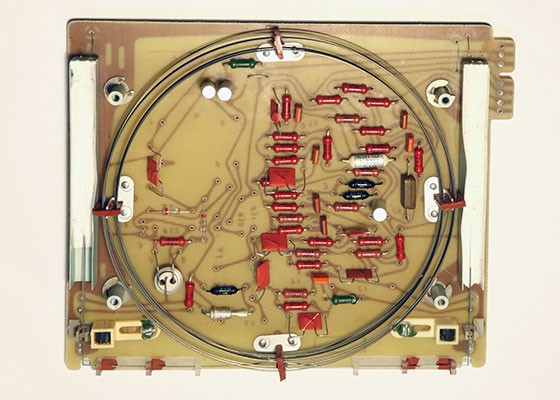
Now, you can go on about your bogus brackets until you’re blue in the face, but the fact is that this isn’t “wrong”. It has a different convention for a sensible reason and if you expect something different then it is you who are using the device wrong.
From your other comment, since having two threads seems pointless:
What do you mean “we don’t”? I just made the definition. It exists. This is why terms like “notation definition” are not actually helpful IMO, so let’s be precise and use terms that are either plain english (like “convention”) or mathematical (like “axiom”, “definition”, etc).
Yes you can. I’m not sure what you’re not understanding about Division before Addition 😂
No it isn’t! 😂
Flat wrong, as per the rules Of Maths 🙄
So stop doing wrong things and I can stop saying you’re doing it wrong 😂
If you have 1 2 litre bottle of milk, and 4 3 litre bottles of milk, even a 3rd grader can count up and tell you how many litres there are, and that any other answer is wrong. 🙄 2+3x4=2+3+3+3+3=14 correct 2+3x4=5x4=5+5+5+5=20 wrong See how the Maths doesn’t work regardless? 😂
Nope, I’ve proven it myself - that’s the beauty of Maths, that anyone at all can try it for themselves and find out. I’m guessing that you didn’t try it yourself 😂
says person failing to give a single such example 🙄
No it isn’t. I’m required to to get the Masters degree which is required to be a teacher here, and that’s the end of it.
The correct way, yes 😂
Nope, neither.
What don’t you understand about 20 being a wrong answer for 2+3x4??
Thing which results in wrong answers if disobeyed - like 2+3x4=20 - not complicated. This is what we teach to students - if you always obey all the rules then you will always get the correct answer.
Of course not, just a different function of Maths, that doesn’t involve Arithmetic at all (other than the steps along the way in doing the long division), unlike 2+3x4 🙄
Nope! Just a different rule to Arithmetic 🙄
Same thing as we’re adding the 2 in 2+3 without writing a plus (or a zero) in front of the 2 - all Arithmetic starts from zero on the number-line. Maths textbooks explicitly teach this, that we can leave the sign omitted at the start if it’s a plus.
Just like we aren’t writing the plus sign in 2+3 🙄
Nope. Same order as though we did write it in a notation using Brackets, same as we always start with adding the 2 even though we didn’t write a plus sign in 2+3.
No you can’t, because you get a wrong answer 🙄
No it doesn’t, Multiplication before Addition 🙄
You know we were writing this without brackets for several centuries before we started using brackets in Maths, right?? 😂
Nope. proven rules 🙄
No we can’t. Even a 3rd grader who is counting up can tell you that 🙄
Yes it does. Again ask the 3rd grader how many litres we have, and then try doing Addition first to get that answer 😂
No we can’t. Ask the 3rd grader, or even try it yourself with Cuisenaire rods
Nope. proven rules 🙄
Count up how many litres we have 🙄
wrong answers 😂
As per Maths textbooks 😂
rule
says person ignoring the Maths textbooks I quoted and the actual calculators giving the correct answer 🙄
Nope! proven rules as found in Maths textbooks 🙄
says person ignoring the Maths textbooks I quoted and the actual calculators giving the correct answer 🙄
Demonstrably not 😂
No they don’t! 😂
The Windows calculator is an e-calc which was written by a programmer who didn’t check that their Maths was correct. 🙄 Now try it with any actual calculator 🙄
Written by a different programmer, but one who didn’t know The Distributive Law, so even in Scientific mode it gives wrong answers to 8/2(1+3) 🙄
No it isn’t. All basic calculators obey Multiplication before Addition, 🙄 and if the programmer had tried it then they would’ve found that out
Instead of using the stack, to store the Multiplication first, like all actual calculators do 🙄
No, the dumb programmer is. All actual calculators did the Multiplication first and put the result on the stack
But actual calculators have put that result on the stack 🙄
No it wasn’t. All calculators “in the early days” used the stack
Nope, it’s just disobeying the rules of Maths because dumb programmer didn’t check their Maths was correct 🙄
And even then the stack existed 🙄
Yes it is! 😂 Again, ask the 3rd grader to count up and tell you the correct answer
knows the rules of Maths 🙄
What don’t you understand about “we don’t”?
Of the notation, not the rules 🙄
And this notation says to do paired operations first, same as if they were in Brackets. You so nearly had it 🙄
says person who keeps calling the rules “convention” 🙄
You know we have Mathematical definitions of the difference between conventions and rules, right??