I was responding to the following paragraph in the article:
We used to get proof-of-thought for free because producing a patch took real effort. Now that writing code is cheap, verification becomes the real proof-of-work. I mean proof of work in the original sense: effort that leaves a trail: careful reviews, assumption checks, simulations, stress tests, design notes, postmortems. That trail is hard to fake. [emphasis mine] In a world where AI says anything with confidence and the tone never changes, skepticism becomes the scarce resource.
I am a bit wary that the trail of verification will continue to be so “hard to fake”.
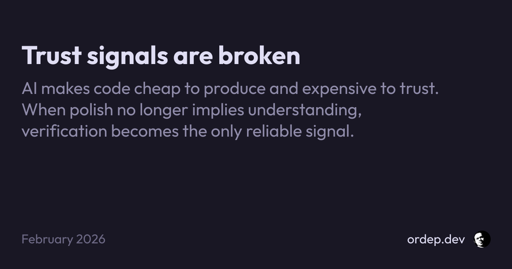
Right, I guess I’m more taking issue with the article than with you, because the “trail” is always documents, and it’s pretty easy for LLMs to fake documents. I mean, humans have been half-assing verification checks for decades, and it has kind of worked because even half-assing a verification document has required at least some fluency with the code under test, which in turn has required the engineering team to develop enough understanding of the code that they can maintain it, just to produce plausible verification trail documents. Now, the relationship between plausible documentation and a dev’s understanding of the code being verified is much less reliable, so we need more precise mechanisms. In other words, the signals of trust have always been broken, it’s just that it hasn’t been a problem up until now because there were side effects that made the signals a good-enough proxy for what we actually wanted. Now that proxy is no longer reliable.


I was responding to the following paragraph in the article:
I am a bit wary that the trail of verification will continue to be so “hard to fake”.
Right, I guess I’m more taking issue with the article than with you, because the “trail” is always documents, and it’s pretty easy for LLMs to fake documents. I mean, humans have been half-assing verification checks for decades, and it has kind of worked because even half-assing a verification document has required at least some fluency with the code under test, which in turn has required the engineering team to develop enough understanding of the code that they can maintain it, just to produce plausible verification trail documents. Now, the relationship between plausible documentation and a dev’s understanding of the code being verified is much less reliable, so we need more precise mechanisms. In other words, the signals of trust have always been broken, it’s just that it hasn’t been a problem up until now because there were side effects that made the signals a good-enough proxy for what we actually wanted. Now that proxy is no longer reliable.