

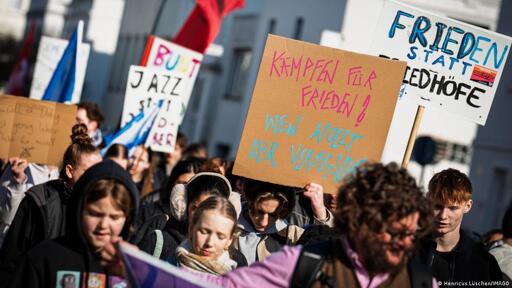
Young people gathered in Berlin’s central Potsdamer Square on Thursday and marched through the German capital to protest against the government’s plans to reintroduce military service. While the police counted around 3,000 participants, organizers claimed there were 6,000 demonstrators in Berlin and 50,000 in more than 130 towns and cities across Germany.
The law says that the service is mandatory. You can join the military or alternatively do some civil service. The issue is, however, that the law only says that it’s mandatory for males. Females are allowed to join the military if they want, but they don’t have to. That law can be changed, but there’s no political majority for it.
That means that if you’re a young girl you can go to university, start working, do your apprenticeship, or do some work and travel in Australia and if you’re a male you can be drafted to the military. So that kind of explains the demonstrations.
But as i can tell from my own experience: males can be drafted, but their draft can be declined if you are unfit, or don’t want to join. In the latter case you have to do civil service. I did civil service for 10 months, one of them was paid time off and the payment was rather good (free food and lodging, and 900€ on top)
As long as there is no real compensation for the gender payment gap or the pregnancy, i am a ok that they have a pass.
So the youth is protesting against compulsory military service because of gender inequality, that‘s your take here? I wish you‘d just not comment at all, if you have no idea, what you‘re actually talking about. That‘s really the dumbest take I‘ve heard, yet.
Also, if anything: „If you‘re a young
girlwoman“, because I do hope you‘re not talking about child soldiers, but are merely a sexist dipshit.Schönen Frauentag.
The take is: One of the reasons why there are these protests is because the way the military service is getting reinstated is deeply unfair. Not sure why you are talking about child soldiers and why you are trying to insult me.
I agree. Incidentally, they did use “males” for “men”, so they were derogatory to both sexes equally.
English is not my first language, so please do not judge my language too harshly. Can you tell me what I should have used here? Because I know “male” and “female” is the official translation of the german gov for my sex/gender in my passport , f.e. used here. So why is it wrong?
I know in Spanish «male» and «female» is used in a biological way, as in «a male human», so calling a woman «a female» (or a man «a male») is seen as treating them as animals, as not the same as you. I think it’s the same in English (as the r/MenAndFemales Reddit page suggests), but I can’t confirm this in any dictionary.
I really feel that I stumbled into a kind of crazy debate. I googled around and you can find articles referring to “males” and “females” in a human context from the most reliable sources. Wikipedia does it. The NIH does it. You can find it in newspapers like the Guardian. You can find statistics from the world bank about “females” and “males” per country. And then you have a vicious debate on Reddit (and here) where users are attacking others as sexist if they use the term.
English is not my native language, but I am not sure where this is coming from. The animal connection doesn’t seem to be correct to me as the general usage just seems to be a plural of “male” and “female”? And some people seem to think that “men” and “women” would be better terms, but those terms are usually referring to adults and not boys and girls?
So you never learned basic English? And now you have to refer to your passport in order to be able to distinguish men from women? lol, sure bro.
Man/men, woman/women, people, humans.
Male and female are adjectives to describe sex. Man and Woman are cultural gender roles, which would be the right choice here.
Probably a bit complicated in some cases, as all this a a fairly recent cultural topic and some people actively struggle with a changing culture that‘s not strongly patriarchal, but either way, male and female is something you use maybe in more clinical or scientific settings, i.e. a female human.
Using female for woman is a bit like using „Weib“ in German.