cross-posted from: https://feddit.org/post/28133646
The war goes on, and so does the global energy crisis. In fact, I believe that prices of oil futures remain too low given how much spot prices will need to rise to resolve the shortages that will hit once oil supplies that were shipped before the Strait of Hormuz was closed are exhausted.
But a better future is coming, despite Donald Trump’s assault on renewable energy as he tries to drag us back into the fossil fuel past. Regardless of Trump’s chest-thumping, America is not the world. We account for only 15 percent of global energy consumption, compared with China’s 28 percent. And the rest of the world is moving rapidly to renewables, thanks to a technological revolution in solar power, wind power, and, less visibly, batteries.
So let me take an optimism break and talk about why batteries may save the world.
The decline in battery prices has been incredible. It’s like nothing anyone has ever seen before. Big, strong men with tears in their eyes come up to me and say, “Sir, have you seen the progress in batteries?”
Why does this matter?
[ … ]
Furthermore, we’ve seen rapid progress in all components of the green energy transformation, even though their underlying technologies have little in common. Solar panels, wind turbines, and batteries are very different, yet all have seen revolutionary improvements. This strongly suggests that the whole renewable energy complex is experiencing a virtuous circle: ever-growing use leads to falling costs and falling costs lead to ever-growing use.
[ … ]
So although we are now in the midst of a severe energy crisis that could easily go on for many months, this too shall pass. A better, cheaper, cleaner energy future is on the way, and not even Trump can stop it.
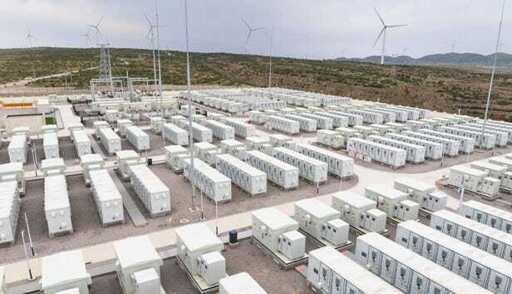
Can someone with more knowledge about energy stuff tell me if we can put solar panels on top of these batteries in the thumbnail, and if not, why?
Perks:
- less land space used and/or better use of sunlight
- less sunlight hitting the batteries = less overhear
- direct connection between source and batteries, just like it is with wind turbines here
Might be an issue with access. If the batteries store high voltage like in cars, you need some training and lock the area before you can work on it because it’s a safety hazard. So it’s just more practical to build panels a few meters away.
Fire protection basically. There doesn’t seem to be a lack of space and the battery containers seem to be placed in a way that they can be left to burn out individually without destroying the rest.
Paul Krugman writes:
The war goes on, and so does the global energy crisis. In fact, I believe that prices of oil futures remain too low given how much spot prices will need to rise to resolve the shortages that will hit once oil supplies that were shipped before the Strait of Hormuz was closed are exhausted.
I think this should be appreciated and realized more. The Street of Hormuz accounted for 20% of global delivery of oil and gas. Even if Saudi Arabia can re-route 5% through pipelines, the shortfall in supply will be 15%.
The thing is that the physical shortfall is only beginning to reach Western Europe and the US, since oil tankers from the Persian Gulf move slow and take four to six weeks to reach these regions. But oil futures should reflect that predictable scarcity, and they don’t do that fully.
Since this oil is not there, and will not arrive, prices have to rise so high that 15% of oil demand is destructed. This probably not happen by just doing less weekend car driving. We are in for a serious crisis. Our economies have to re-structure to require less energy, in order to stay competitive. (Luckily, there are a lot low-handing fruits that can be harvested now. We had (and used) similar opportunities in the past. One well-known example is moving knowledge work to home office. Another is the transformation of drives in the automation industry from pneumatic drives to electrical ones - this is saving a lot of energy.) All of this requires change.
In the West, the shortage is only starting to become noticeable, in areas like aviation.
Disturbingly, markets and most mass media behave, contrary to the known facts, as if the shortfall would be resolved in a few weeks. (It reminds me in the beginning of the Corona crisis in January 2020, when it was clear that “Houston, we have a problem”, but many countries took more than three full months to react to that problem.) But it will take years to repair the oil infrastructure around the Golf coast. Given that a global revolution in renewable energy is happening, and future power generation is now replaced rapidly by solar, batteries, and wind it might even happen that some of it never comes back, because it is too uncertain that the cost of repairs become profitable.
The false appearance that this crisis will be over soon is already harming people, it leads to wrong decisions. For example, some people wait to fill up their storage for heating oil, waiting for lower prices.
If I were a house owner with oil heating and an oil tank, I would not wait, but fill the tank up now, to the brim. Oil will not get cheaper in the next few years. Waiting for cheap heating fuel will only help speculators, as is any talk from the US about ending that war soon.
If I were looking to by a new car (assuming I actually needed one), I would look to buy a used electric one. And without waiting, because the used EV market could be empty soon.
If I were changing jobs and moving home, I’d chose a location and commute with the least commuting distance possible. Including public transport, because it might happen to become very strained, too.
If I were worker in an industry with energy-intensive products, like ICE cars, aviation, construction, paper, long-distance tourism, I would look for a more future-proof job now - because these industries will get massive problems.
Similar clear-sighted decisions have to be taken in companies and industry. For example, according to experts we will likely see a severe shortfall on oil and gas by-products and petrochemicals, things like fertilizer, phosphate, urea, helium, sulphur, and consequently products of these, including food, microchips, plastics, copper, aluminium, and so on.
Europe has a role in this:
Furthermore, we’ve seen rapid progress in all components of the green energy transformation, even though their underlying technologies have little in common. Solar panels, wind turbines, and batteries are very different, yet all have seen revolutionary improvements. This strongly suggests that the whole renewable energy complex is experiencing a virtuous circle: ever-growing use leads to falling costs and falling costs lead to ever-growing use.
If we ask where this virtuous circle is taking place, the answer is, largely in China with an assist from Europe. And the corollary is “not in America.” The United States has allowed itself to be far surpassed by China and is now only a peripheral player in the renewable revolution. Fortunately for the rest of the world, this means that the Trump administration’s hostility to renewable energy, its attempts to sabotage progress, won’t stop that revolution or even noticeably slow its momentum. True, Trump’s anti-green, pro-pollution tilt will serve to leave America further behind, but progress in fighting climate change and reducing the risks of global dependence on oil will continue.
Europe has a role in this
STILL. NOT. ENOUGH.
🇪🇺
Reminder that the solar panel was invented at Bell Labs in 1954 :'/
Actually, the progress in solar energy since that, based on fundamental research, automation, battery technology, and so on, is a stunning testimony to human cooperation and ingenuity, like the Covid vaccine. Twenty years ago, the opportunity we have now was hardly imaginable, the technology we have now would have sounded like pure science fiction.
Oh, and then we have this brilliant high-tech invention.
Actually, it was first devised by a German polymath in 1817, when Europe had just experienced a “year without summer” after the explosion of a big volcano in Indonesia, which led to lack of sunlight, bad harvests, a food crisis. and famine in Europe. As the (unconfirmed) legend goes, this was also affecting horses, and he sought for a way to replace them.
I am sure that if ever empathic aliens would visit planet Earth, they would like the story, much more than the pictures of Hiroshima and Vietnam.