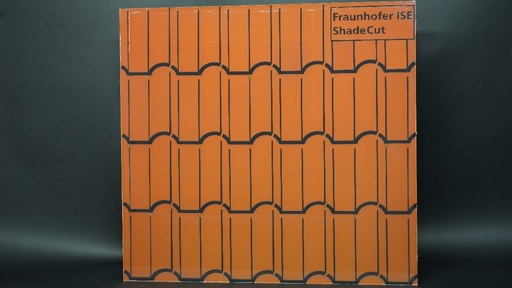
And the use case is only for visual appeal? Good for those who need that. Probably can add advertisement on it to make it cheaper? I’m fine with normal looking one. Maybe it is beneficial, as it might reduce the performance at first but might keep temperatures lower and so increases efficiency again? Solar power is just great and it should get to a point where there is no more question about if it is worth it and will just get added to every roof that gets sun.
If they can find a way to make the panels usable and still have aesthetic appeal then they could be used for signage and shit too.
While I don’t say yay more signage I do say yay more solar, so like a lose-win
In some cases, you are not allowed to install regular solar panel in my country. If you live near an historical monument, it can be impossible because it would clash with it. These solutions could be an alternative.
Personal taste doesn’t matter when you have to deal with American HOAs or the German Denkmalschutz (Monument Protection Agency). This tech is a godsend.
A lot of people take pride in the appearance of their house, and solar panels could totally alter the appearance of a house, especially one designed in a particular architectural style.
Yeah, make it look cooler. Solar panels still look like fancy future tech to me. I’m always reminded of the ISS. So I stand by it, they just look cool.
There are plenty of people who seem to only manage to conjure up “but they’re ugly” as reasons to not have panels and policy supporting their adoption
Sometimes it’s worth something existing simply to reduce the arguments against it
i want a solar array infused with an LED array so that i can make my roof a giant compass and clock for planes and helicopters at night and make QR codes on my roof to NGGYUNGLYG pilots. If we gonna lose the night sky to satellites i’m gonna need a bigger screen, Pete.
Get panels made from material with a direct band gap like GaAs.
*NGGYUNGLYD, you mean?
Cheers! I have corrected it, and I have added that to my spell check dictionary.
LEDs can work a bad solar panels.
95% performance of regular cells or 95% performance of turning light into electricity? It sounds like the latter but it can only be the former.
Yeah, that’s a bit of a misleading headline.
Yea. 95% efficient panel is Nobel prize level of story, making it look like a roofing tile would not even be a bullet point in the story
It’s also way above the limit of a regular single layer solar. I think the theoretical limit was around 30% which can only be surpassed by having multiple layers like with perovskites.
It’s also a physical impossibility iirc
I think plants are pretty close?
Surprisingly not! I’d have expected photosynthesis to have similar energy efficiency to man-made solar panels, but it’s actually only around 11%. I suppose since leaves have more functions than just energy generation for a plant, it’s not usually an evolutionary imerative to maximise efficiency. There’s probably a bit of variation between different geographic regions, I’d imagine.
It depends how you’re defining it. 95% of all wavelengths that hit it being converted is impossible, because solar panels only work within certain spectral ranges, but it’s theoretically possible, although technically difficult, to have 95% of all relevant wavelength photons converted into electricity.
For a p-n junction based cell, the theoretical maximum efficiency is about 33%.
You can game this a bit using tandem cells with layers of varying bandgaps, but even as the number of layers approaches infinity the theoretical maximum only increases to about 68%. They’re also not hugely practical or cheap, obviously, and in practice they barely reach above the regular limit of 33% due to engineering constraints. There are some other ways of trying to get around it, but I don’t know of any that can approach 95% efficiency.
Worth noting that this is staggeringly high efficiency in comparison to most other energy sources, given that at the end of the day all of them ultimately come from sunlight.
You could potentially get up to 90% (maybe more) efficiency with an optical recetnna. Though manufacturing one is presently out of reach.
Ooh cool I hadn’t heard of them! My understanding from the wiki page though is that the 90% efficiency refers to energy transfer efficiency within the microwave range, rather than the conversion rate from sunlight which is theorised to be about 70%. The stuff about generating power in space using solar cells then transferring it back to earth sounds awesome, though possibly a bit impractical compared to regular solar farms.
The latter is physically impossible.
All this and more, for the low low price of actually reading the article:
It enables complex visual patterns while also retaining approximately 95 percent of the power output of an uncoated module.
Well that’s clearly nonsense. I think the highest efficiency ever recorded for a solar panel was 2.4% so 95% is definitely not right.
What they probably mean is 95% of the efficiency of a black solar cell. I.e. you don’t lose too much just to keep the HOA happy. Although black slate roof tiles are actually a thing as well.
What they probably mean
You mean what is clearly stated in the article?
Dude imagine reading the article before commenting ! Revolutionary ideas <3
The title is ambiguous, though
My initial understanding was 95% of a normal panel. So not that ambiguous
You are above average
I did read the article. But I’m talking about just the new information we can gleam from the headline. Because that’s the thing that’s been disingenuous.
The thing is, most people with no technical background will probably get the right meaning from the headline even though it’s phrased wrong. I sure did. Because when you buy solar planes, you usually compare efficiency of different products and placements, not the actual efficiency factor.
24 to 25% efficiency, based on a quick search. But they are talking a difference in terms and measures. While they may only convert 24%, they still produce 90 to 95% of their stated power output. In short, how fast they can charge a battery vs, how many things can they actively run.
HOA? I don’t think this is such a thing in Europe, at least not in Portugal. wandering if it’s a american defaultism thing
We have them in Iceland for multi tenant buildings such as blocks for handling outside repairs etc. Nobody has them for a whole street since with rules on how often the lawn needs to be moved like in the US.
Though we do have a lot of places everywhere in Europe that restrict how buildings can look, often for tourism reasons.
controlled by the government and local law, not your neighbor
You meant 24%? And i have seen news about 32% years ago, although with concentrating lenses as part of the cell.
Looking online I’ve seen claims up to 50% but I’ve also seen lots of discussion online about how those numbers can’t be relied on.
what does it mean actually?
100% would mean it absorbs the sun completely?
There is 2 things that are measured in efficiency.
The first thing is as you mentioned, how much of the solar energy is absorbed. 100% would mean that all the solar energy on the surface of the cell would be absorbed.
The second thing is how much of the absorbed energy of the solar cell is converted into usable energy.
For a square meter of sun, there is about 1kW of energy, or 1000W.
If the solar panel of one square meter is efficient at 50% to absorb the solar energy, 500W would be available.
Then, if the circuitry is 90% efficient at converting the absorbed energy into usable power, you would get 450W of usable power.
The overall system efficiency is 450W/1000W, or 45%. So 45% of the solar power that hits the solar panel is usable at the output of the whole system.
This is a really watered down version of how things really work, but that should help you navigate this article.