One question, why left handed? The physics would need to be rewritten in the left-handed paradigm, for anything more complicated than simple local behavior simulations, like collisions, constant gravity, etc. A single charged particle in a B and E field would be hell hahaha. Edit: I think it would be adding one - sign at the x.
I know that these more “advanced” simulations wouldn’t normally appear in a game, but they would be a lot harder, and they are effectively the same as fluid and cloth simulation in videogames (just balls and meshs, affected by forces, integrated over time on the gpu).
Tradition, 3d videogames started doing it like that because of how computers worked 40 years ago, then devs got used to think about 3d space that way and it stuck. Essentially videogames think about visual depth. And yes, the physics engines for videogames usually account for that and use their own transformations of formulas because they are rarely simulating anything more complex than rigid body physics. Advanced simulations aren’t any harder for devs, all the transformations are abstracted away with libraries.
In the end they are just reference frames and up is whatever you want it to be. As Wikipedia puts it eloquently: “Unlike most mathematical concepts, the meaning of a right-handed coordinate system cannot be expressed in terms of any mathematical axioms. Rather, the definition depends on chiral phenomena in the physical world, for example the culturally transmitted meaning of right and left hands, a majority human population with dominant right hand, or certain phenomena involving the weak force.”
Yeah, but it would be ctrl c ctrl v on the equations vs getting a lot of - signs for nothing hahaha. Imagine writing the shaders for animations, like explosions, torque, etc, working for cinema 4d, might be a pain in the ass.
Not really. Youtuber Acerola has a great series on shader programming and dealing with negative numbers is a non-factor. The advantage of working with computers is that it abstracts that complexity away. You program with high level concepts, a dev rarely deals with direct calculations, unless they are actually writing the fundamental apis for it, like DX or Vulkan. Much less copy-paste formulas. It gets complicated fast, but the abstraction keeps it simple for the developer, like, the math is perhaps the easiest part of programming computer graphics.
Yeah, i was refering to building the fundamental equations, deriving all things in a left handed way and forgetting a - sign.
Like the tensors for building the movement of rigid bodies in a left handed way, calculating jacobians, etc. The - signs start coming and don’t stop coming.
I never built something on these abstractions, just made the equations themselves.
It’s okay. The equations have been done since a long time ago. Devs don’t have to think about it much. Essentially, computer simulations already have their own body of math that you probably were not taught in physics, because they aren’t relevant for real world physics study.
Yeah, and you probably used libraries that abstracted the math away so you could focus on your simulations instead of thinking about transforming negative signs for the GPUs. That’s already figured out.


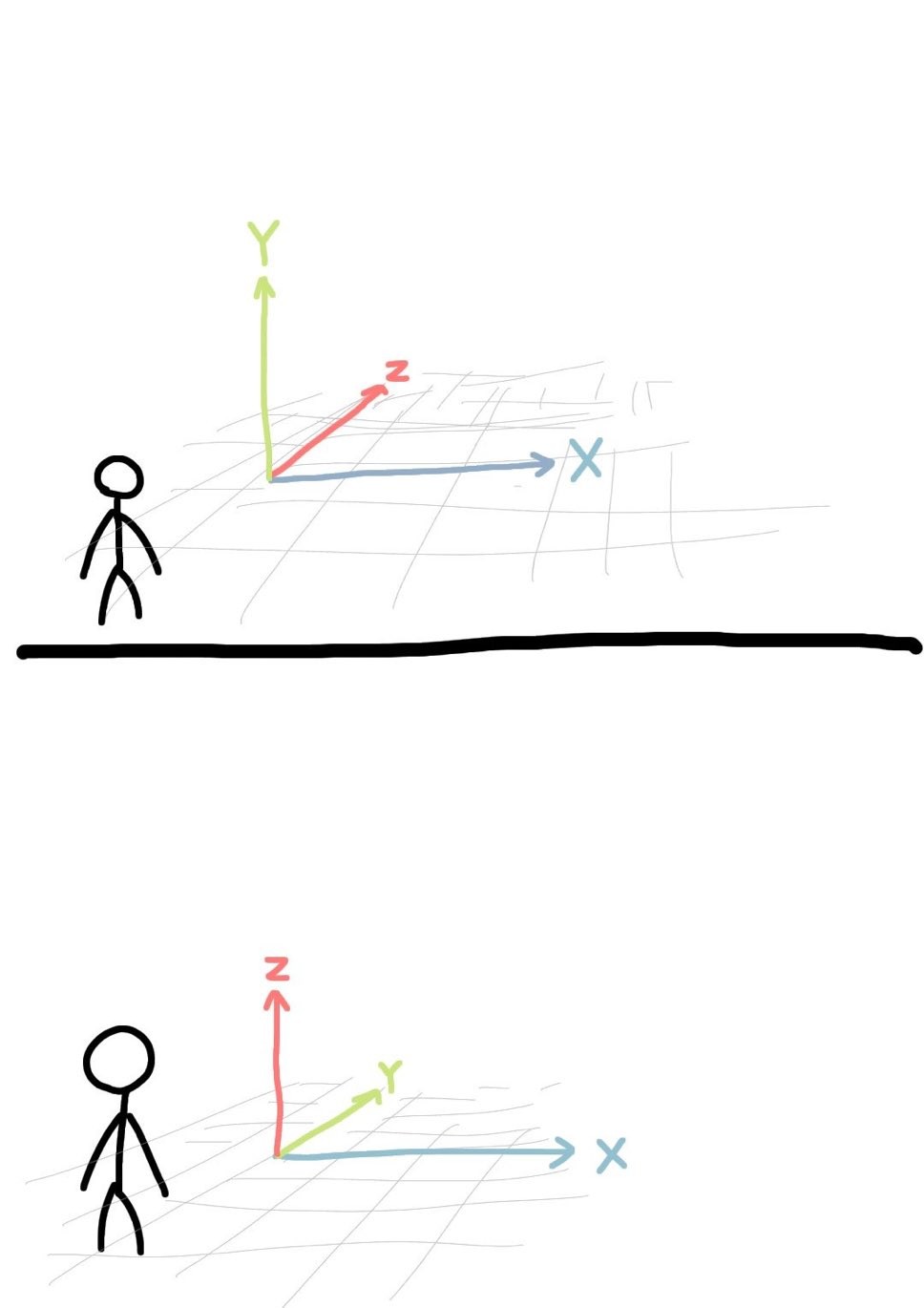
One question, why left handed? The physics would need to be rewritten in the left-handed paradigm, for anything more complicated than simple local behavior simulations, like collisions, constant gravity, etc. A single charged particle in a B and E field would be hell hahaha. Edit: I think it would be adding one - sign at the x.
I know that these more “advanced” simulations wouldn’t normally appear in a game, but they would be a lot harder, and they are effectively the same as fluid and cloth simulation in videogames (just balls and meshs, affected by forces, integrated over time on the gpu).
Tradition, 3d videogames started doing it like that because of how computers worked 40 years ago, then devs got used to think about 3d space that way and it stuck. Essentially videogames think about visual depth. And yes, the physics engines for videogames usually account for that and use their own transformations of formulas because they are rarely simulating anything more complex than rigid body physics. Advanced simulations aren’t any harder for devs, all the transformations are abstracted away with libraries.
In the end they are just reference frames and up is whatever you want it to be. As Wikipedia puts it eloquently: “Unlike most mathematical concepts, the meaning of a right-handed coordinate system cannot be expressed in terms of any mathematical axioms. Rather, the definition depends on chiral phenomena in the physical world, for example the culturally transmitted meaning of right and left hands, a majority human population with dominant right hand, or certain phenomena involving the weak force.”
Yeah, but it would be ctrl c ctrl v on the equations vs getting a lot of - signs for nothing hahaha. Imagine writing the shaders for animations, like explosions, torque, etc, working for cinema 4d, might be a pain in the ass.
Not really. Youtuber Acerola has a great series on shader programming and dealing with negative numbers is a non-factor. The advantage of working with computers is that it abstracts that complexity away. You program with high level concepts, a dev rarely deals with direct calculations, unless they are actually writing the fundamental apis for it, like DX or Vulkan. Much less copy-paste formulas. It gets complicated fast, but the abstraction keeps it simple for the developer, like, the math is perhaps the easiest part of programming computer graphics.
Yeah, i was refering to building the fundamental equations, deriving all things in a left handed way and forgetting a - sign.
Like the tensors for building the movement of rigid bodies in a left handed way, calculating jacobians, etc. The - signs start coming and don’t stop coming.
I never built something on these abstractions, just made the equations themselves.
It’s okay. The equations have been done since a long time ago. Devs don’t have to think about it much. Essentially, computer simulations already have their own body of math that you probably were not taught in physics, because they aren’t relevant for real world physics study.
I did research in numerical calculus and physical simulations hahaha. Sound wave and polarized electromagnetic wave propagation in porous media.
Yeah, and you probably used libraries that abstracted the math away so you could focus on your simulations instead of thinking about transforming negative signs for the GPUs. That’s already figured out.
Ace is a decent watch. Shit post quality video energy, that’s information dense. Always gonna second an Acerola suggestion.